
Are the Olympics really politically neutral?
The Olympics, a grand stage for athletic prowess, ostensibly champions unity and peaceful competition among nations. Yet history reveals a complex interplay of human rights and sports challenging the perception of the Olympics as a politically neutral ground. From boycotts and protests to the interplay of global politics, the Games have often mirrored the world's socio-political landscape.
Rule 50 of the International Olympic Committee’s (IOC) Olympic Charter states “No kind of demonstration or political religious or racial propaganda is permitted in any Olympic sites, venues or other areas.” Athletes are prohibited from displaying any political messaging, including signs or armbands as well as gestures of a political nature, such as hand gestures or kneeling. The purpose of the rule is to focus on sports, not politics. But in a volatile and insecure geopolitical landscape - has this always been possible?
One of the earliest and most prominent examples of political exploitation of the Olympics was the 1936 Berlin Games. Nazi Germany used the event to showcase its regime’s strength and ideology, sidestepping the grim realities of persecution against Jews and other minorities. The event aimed to project an image of a peaceful and powerful nation. However, African American athlete Jesse Owens' extraordinary performance, winning four gold medals, contradicted Hitler’s narrative of Aryan racial superiority, underscoring the complex interplay of sports and politics.
The 1968 Mexico City Olympics were a platform for a significant political protest when African American athletes Tommie Smith and John Carlos raised their black-gloved fists during the US national anthem. This Black Power salute was a protest against racial discrimination and a call for human rights in the United States. Their actions led to their suspension from the Games and widespread controversy, but the image of their protest has become an enduring symbol of the civil rights movement. Smith and Carlos were the first two athletes to join The Olympic Project for Human Rights led by Dr Harry Edwards. The project aimed to use the Olympic stage to draw attention to racial segregation in the US, but evolved to a much larger campaign highlighting racial injustice within sport. The organisation advocated for a boycott of the 1968 games unless five conditions were met.

USA Olympians Tommie Smith and John Carlos raise a black fist in protest against racial discrimination in the states.
One of their five conditions to the IOC was that they must uninvite South Africa due to their apartheid regime. Starting in 1964, South Africa was banned from the Olympics due to its racist policies. This ban lasted until 1992, reflecting the international community's stance against apartheid and using the Games as a platform to pressure the South African government to change its policies. This prolonged exclusion demonstrated the global commitment to human rights and equality, using the Olympics as leverage for political and social change.
In 1980, the Moscow Olympics were severely affected by a large-scale boycott led by the United States in response to the Soviet Union's invasion of Afghanistan. Over 60 countries joined the boycott, significantly diminishing the Games’ competitiveness and highlighting the Cold War's impact on international relations. This boycott was a clear example of how geopolitical tensions can influence the Olympics, turning them into a stage for political statements.
The 2014 Sochi Winter Olympics were overshadowed by Russia's controversial anti-LGBTQ+ laws. International protests erupted, condemning these laws as discriminatory and a violation of human rights. Activists and athletes used the global spotlight of the Olympics to draw attention to the plight of the LGBTQ+ community in Russia, although the laws themselves remained unchanged.

Amnesty International Olympic Torch run in San Francisco to protest Russia LGBT law. Photo: Steve Rhodes
In 2021, the Tokyo Olympics saw Russia’s national team competing under ‘Russian Olympic Committee (R.O.C)' due to state-sponsored doping violations. Athletes who were not involved in the doping scandal and able to compete under R.O.C were banned from displaying any association with their country and made to wear neutral coloured sportswear.
Following Russia’s invasion of Ukraine in 2022, Russia and Belarus have been banned from the Paris 2024 Olympics. Athletes who demonstrate they do not support the war in Ukraine will be able to compete under the Individual Neutral Athlete (INA) banner, if they pass the criteria set out by the International Olympic Committee (IOC). Government and State officials are banned from attending the games and fans will not be allowed to display Russian or Belarusian flags during the Games. In stark contrast, Israel’s national team faced no such restrictions despite ongoing allegations of human rights abuses in Gaza. This inconsistency raised questions about the IOC approach to political and human rights issues, challenging the notion of uniform enforcement of rules.
The impact of the Israel-Gaza conflict on the Olympics is particularly poignant. The 1972 Munich Olympics witnessed the horrific massacre of 11 Israeli athletes by Palestinian militants, a tragedy that underscored the volatile intersection of political tensions and the security of the Games. This event is at the forefront of a recent controversy involving sports brand Adidas. The German company re-released a retro shoe created for the Munich Olympics, featuring a campaign with Half-Palestinian supermodel, Bella Hadid. The campaign faced backlash due to the sensitive historical context, leading to its withdrawal. Bella Hadid, a vocal advocate for Palestine, subsequently sued Adidas, accusing the company of failing to consider the implications of her involvement given the historical and political connections.
Palestine is competing in the Paris 2024 Olympics making it their 8th appearance in the Games. In the lead up to the event concerns have been raised about Palestine’s ability to compete, as 69 Palestinian Athletes have reportedly been killed between October 2023 and July 2024 according to Palestinian Campaign for the Academic and Cultural Boycott of Israel, drawing international condemnation and calls for justice. These deaths highlight the human cost of political conflicts and the role of sports in bringing such issues to the forefront. Many stadiums in the Gaza strip have been destroyed by the Israeli military, or in the case of the Yarmouk Stadium used as a jail to interrogate and humiliate Palestinans. The Palestinian Football Association (PFA) wrote to the IOC and FIFA to ask them to condemn Israel’s actions, but both organisations have failed to take action and ban Israel from sporting events.
Israeli athletes are being given 24 hour protection following a series of death threats being investigated by the French authorities. They have also been the victims of cyber harassment and possible anti-Semitic hate crimes during an Olympic football match.
Whilst sports can be an opportunity to open new negotiations, as seen in the Pyeongchang 2018 Winter Olympics when athletes from North Korea and South Korea walked side by side with a unified Korean flag. With Palestinian Olympic Chief Jibril Rajoub refusing to shake hands with the Israeli Olympic Committee and its athletes unless they recognise Palestine as a state, alongside Ukrainian athletes refusing to shake the hands of Russian or Belarusian athletes, the impact of the war on the Olympic Games has never been more evident. The Olympic truce asks all nations to cease all conflicts from the week before the opening ceremony to the week after the closing ceremony, yet Israel and Russia continue their offences.
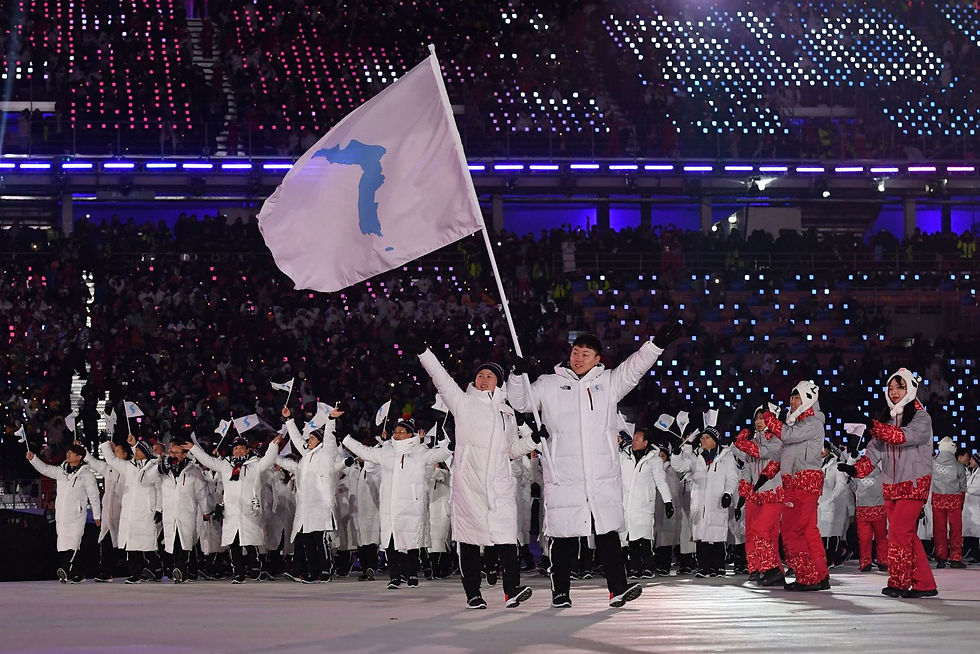
North and South Korean athletes walking together during the Pyeongchang 2018 Winter Olympics opening ceremony. Photo: Mark Ralston/AFP/Getty Images
The Olympics’ claim to political neutrality is further challenged by these and other instances of selective rule enforcement. The differing treatments of Russia and Israel illustrate the complex and often inconsistent application of political neutrality. While the IOC strives to separate sports from politics, the reality is that global events and conflicts inevitably influence the Olympic arena. When athletes are given a global stage to speak out against human rights abuses, it is an opportunity and a risk only some are willing to take.
The Olympics, while promoting ideals of unity and peace, cannot escape the influence of global politics. From historical boycotts and protests to contemporary issues of human rights and geopolitical tensions, the Games reflect the world's complexities. The challenge remains for the IOC to navigate these waters, striving to uphold the spirit of the Olympics while acknowledging and addressing the political realities that athletes and nations face.
Discover more about the political history of the Olympic Games here.


OK9 FOOTBALL mình thấy bạn bè nhắc nên ghé thử cho biết thôi, chủ yếu xem giao diện có dễ dùng không. Vào cái là thấy trang làm khá gọn, khoảng trắng vừa đủ nên nhìn không bị rối mắt. Mình để ý họ chia nội dung theo từng khung rõ ràng, kiểu lướt xuống vẫn nắm được đang ở phần nào chứ không bị dính một cục chữ dài. Cái mình thích nữa là thanh menu đặt ngay chỗ dễ thấy, bấm qua lại mấy mục không cần tìm nhiều, dùng trên điện thoại cũng ổn. Nói chung cảm giác thân thiện với người mới, không cần “học” cách dùng lâu. Nhìn tổng thể thì các khối nội dung…
OK9 mình thấy mọi người nhắc hoài nên cũng bấm vào coi thử cho biết chứ không có ngồi chơi hay đọc kỹ gì đâu. Vừa vào là thấy giao diện khá dễ chịu, kiểu chia khu vực rõ ràng nên mắt không bị loạn, nhìn cái là biết phần nào quan trọng. Mình để ý mấy khối nội dung họ làm dạng thẻ card nên lướt qua nhanh vẫn nắm được, không phải kéo lên kéo xuống nhiều. Thanh menu cũng đặt chỗ dễ thấy, bấm qua lại giữa các mục không bị “lạc” hay phải tìm hoài. Nói chung cảm giác họ sắp xếp gọn gàng, chữ không bị dồn và khoảng trắng vừa đủ nên nhìn thoáng,…
OK 9 hôm trước thấy bạn bè nhắc nên mình bấm vào coi thử cho biết thôi. Mình không có ngồi đọc kỹ hay làm gì nhiều, chủ yếu xem giao diện họ bố trí ra sao. Vừa vào là thấy trang nhìn khá sáng sủa, khoảng trắng vừa đủ nên không bị rối mắt. Mấy phần nội dung được chia thành từng khối rõ ràng, nhìn lướt là biết chỗ nào là thông tin chính, chỗ nào là bảng ô số liệu, đỡ phải đoán. Mình cũng để ý cái thanh menu đặt ngay chỗ dễ thấy, bấm qua lại giữa các mục không bị “lạc”, chuyển trang khá mượt. Nói chung kiểu sắp xếp này hợp với người…
OK9 COOL mình thấy bạn bè nhắc hoài nên cũng ghé thử cho biết, kiểu vào xem giao diện thôi chứ không có ngồi tìm hiểu sâu. Vừa mở ra là thấy trang làm khá “dễ thở”, khoảng trắng nhiều nên nhìn không bị ngợp. Mình thích nhất là cách họ chia nội dung thành từng khối rõ ràng, lướt xuống là nhận ra ngay phần nào với phần nào, không bị dính một cục dài ngoằng. Với lại mấy chỗ thông tin họ trình bày theo dạng bảng cột gọn gàng nên liếc cái là nắm được, khỏi phải đọc nhiều chữ. Menu cũng nằm chỗ dễ thấy, bấm qua lại vài lần là quen tay luôn. Nói chung…
https://fly88.deal/ hôm trước thấy bạn bè nhắc qua nên mình bấm vào coi thử cho biết thôi. Mình không tìm hiểu sâu nội dung gì, chủ yếu xem cách họ làm giao diện. Vào cái là thấy trang sắp xếp khá “gọn mắt”, mấy phần nội dung chia thành từng khối rõ ràng nên lướt xuống không bị rối. Mình cũng để ý phần chữ và bảng/cột trình bày khá ngay ngắn, nhìn nhanh là hiểu chỗ nào đang hiển thị thông tin gì, không phải đọc từng dòng mệt. Menu đặt dễ thấy, bấm qua lại vài lần là quen, cảm giác điều hướng ổn và ít bị lạc. Nói chung mình thích kiểu họ canh lề và chia…